Unions are organs of workers defense, yet they are led by bureaucrats who care only for their perks and privileges. It’s for this reason the brass seek “friends” among the bosses while silencing the rank and file, avoiding the class battles necessary to defend our interests. To empower the membership, and as part of the fight for a new, class-struggle leadership, COFTU calls for:
Average workers’ wages for union officers!
Direct elections of the international president and vice presidents, local chairman, stewards and all union positions!
One year terms and direct recall by simple majority!
Dues collected directly by the union and paid by all—no perks for stewards!
Open negotiations!
Full disclosure and open discussion of contract proposals in advance of a vote, taken at mass meetings!
We, the undersigned Teamsters and supporters of the union movement, demand that the International Brotherhood of Teamsters leadership:
Condemn the state executions of Renee Good and Alex Pretti by ICE and CBP agents.
Organize for an end to any contracts with ICE, including the ICE/UPS contract.
Defend members who refuse to comply with ICE operations on the job.
Hold local meetings, open to all membership in person and on Zoom, to discuss the ongoing state terror against the working class, and the potential use of political strikes to fight back.
Defend the people’s right to bear arms, as is protected by the Second Amendment.
Oppose the spread of the dystopian surveillance technology developed by Palantir and other companies for US federal agencies, which is being used on all people regardless of immigration status and is a test run for fascist rule in the US.
Call for the abolition of ICE, a brutal and anonymous federal police force. The first step is its immediate removal from US cities. ICE is a new and disturbing outgrowth of the state and a product of the so-called “War on Terror.” ICE is not just a threat to immigrants, but to all workers in the US.
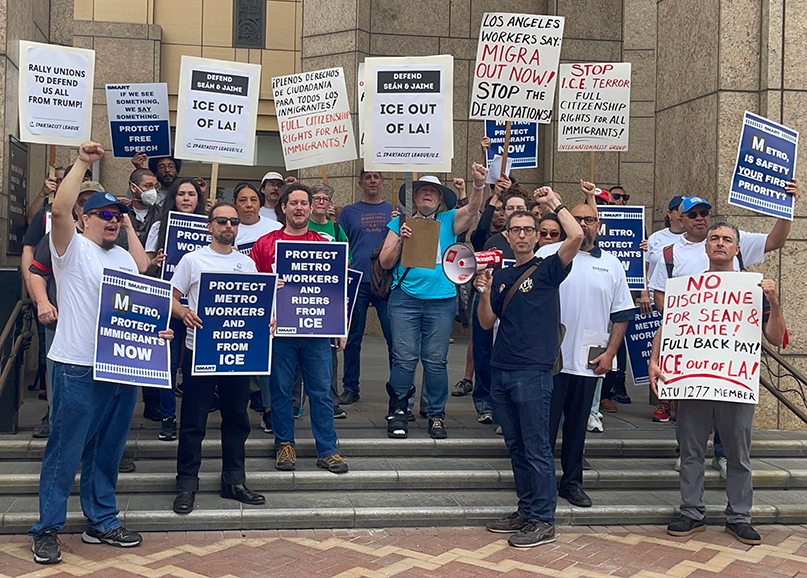
SMART bus operators Seán Broadbent and Jaime went public in the LA Public Press in July saying that they and around 30 of their coworkers had vowed to not let unidentified, masked and armed ICE agents without a warrant onboard. As a result, they were both fired. After Seán went back to the media saying this was retaliatory, the discipline was reduced to a 60-day suspension. But this remains a threat to the rest of the workforce. So we in the Committee for One Fighting Transit Union (COFTU) joined with other Metro workers and formed the Unionists for Seán and Jaime and held a rally on September 25, fighting for clean reinstatements with full backpay.
While the rally was small, various Metro and other unionists and left activists joined in. It was a victory, given the blowback we encountered. TCU leadership refused to engage. ATU mostly stonewalled, only sending a letter to the top dog at SMART which they then refused to make public despite a motion the membership passed calling to do so. A SMART local vice chairman wanted to speak at the rally, but upper leadership ordered him to stand down. Meanwhile, rumors circulated that management would discipline anyone who attended.
All Metro workers must defend these operators! Metro intimidates workers who reach out to the press—including on safety—in order to control the narrative. Many co-workers amplified this, saying “follow the policy” or “it’s not your bus.” But operators are like captains of a ship, they are the stewards of their riders’ safety. What Metro feared most was these drivers’ step toward collective action, taking safety into their own hands, especially in the face of Trump saying that ICE can go anywhere. If the unions can come together now, in the defense of two of their own, it puts us in a good position to defend not just immigrants but the whole Angeleno population.
While all rally participants agreed on the main demands, there was open debate on how best to achieve them. The Democratic Socialists of America and others, for example, pushed for Metro to adopt a “proactive policy” to protect immigrants and a training program on ICE for drivers. But Metro already has a policy: to punish people like Seán and Jaime who stand up to ICE. Metro’s interest is to keep transit moving so the profits of L.A.’s bosses keep flowing. Metro doesn’t care about its own workforce, let alone immigrant riders.
The bosses will not bend to moral pressure to do right. The only pressure they will listen to is the one that effects the bottom line. That’s why COFTU demands that the unions exert their power. The bosses need us, we don’t need them—we make the wheels turn! For more on the rally, watch our video at youtube.com/@foroneunion.
We are divided by race, gender, craft, tier, bus vs rail and union. Who benefits? Only the bosses! Yet LA Metro unions reinforce these divisions. Why? They don’t want to make waves for the company and elected officials.
This is why they only beg the company for crumbs during contract negotiations. This is why they caved and sent people back to work when requested by Democrat “friends” during our strikes in 2000 (UTU/SMART) and 2003 (ATU).
All good boxers go for a knockout. But our leaders enter the ring determined not to go for a K.O. because they support the whole system of profit. You can’t win if you don’t fight!
To win, we need a change. Join us to fight back against the bosses and their fake “friends of labor”-Democrats and Republicans alike.
We call:
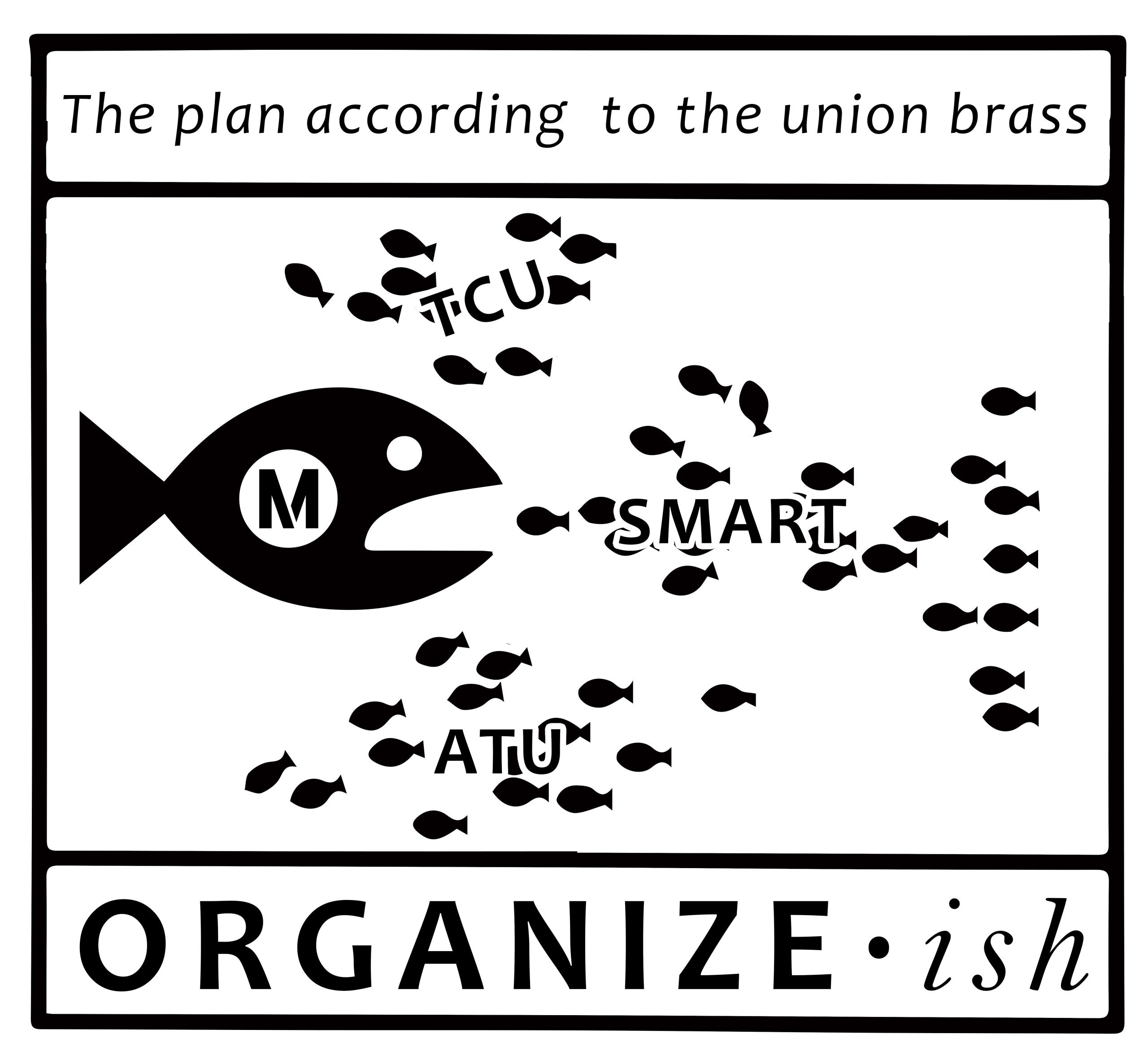
To merge ATU, SMART and TCU to fight for the highest pay and benefits for all!
To stop funding the bosses’ parties, Democrat or Republican! Increase strike funds now!
To abolish tiers and steps! Equal pay for equal work!
To abolish PEPRA second-tier pensions! 23-and-out full & free pensions for all!
To coordinate action across the workforce! Down with union probation and the no-strike clause!
To defend immigrants with union action, not sanctuary state and city scams!
For a fight to end segregation on and off the job!
For free, convenient and plentiful mass transit for all!
No worker will be immune from the tsunami of attacks unleashed by Trump as he remakes the U.S. economy for the bosses’ benefit. Gutted collective bargaining rights and mass layoffs, tariffs and trade wars, rampant inflation and deep recession—the future is anything but bright for working people. Mass transit, like many other vital social services, is on the chopping block as Trump reclaims previously allocated federal funds to reduce or redirect spending to the new priorities of the ruling class. In particular, he is shutting down green initiatives in blue states—putting L.A. Metro’s federally financed Olympics expansion on rather shaky ground. None of this bodes well for Metro’s unionized workforce—or its poor, working-class ridership for that matter.
The Democrats who run the city, county and state are not about to come to the rescue. Their devastation of work- ers’ living standards brought Trump to the fore in the first place, and L.A. mayor Karen Bass is herself about to pick up the ax to chop at jobs and services in response to a near billion-dollar budget shortfall. To hold the line in the face of uncertainty and chaos, it falls to workers to actively defend jobs, working and living conditions and those among the oppressed currently in the crosshairs. But at the moment, the unions—the very organizations that must mobilize such a defense—are ill-prepared for the task confronting them.
The best defense is one rooted in workers’ numbers, common organization and operational unity. But the overall landscape at L.A. Metro is very much the opposite: divisions abound among transit workers. The workforce is around half Latino, who tend to handle the dirtier jobs, laboring beside Asian immigrants, themselves divided by nationality. White workers are a decided minority, largely concentrated in higher-paid positions, whereas black workers and women fill lower-paid job titles. These divisions—by race, by nationality, by craft—are deepened and hardened by divisions in organi- zation. Transit workers are split into three separate unions and multiple locals: ATU Local 1277 (mechanics and service attendants), TCU Local 1315 (custodians and clerical workers) and six SMART locals (bus and rail operators). These dividing lines are further enforced by resetting the seniority of any worker who switches jobs between them.
“Divide and rule” is the name of the bosses’ game, and the union leaderships are willing players, not least by fiercely throwing up barriers to merging the unions in order to pro- tect their turf at the membership’s expense. These barriers only magnify the racial, ethnic and gender divisions that rear their ugly head daily, often in the fight over the scarce bit of “privileges” that Metro doles out. The bosses wield their control over promotions to higher tiers and qualifications to promote an individualistic consciousness among workers, who are pitted against one another for access to overtime, job training and cleaner, easier job assignments (often along racial lines).
This dog-eat-dog scramble among workers to pro- tect their livelihoods is only going to intensify as things go increasingly downhill. The crackdown on immigrants and other oppressed sectors in society at large cannot but find reflection inside the unions. Every form of antagonism will be further aggravated, and the pressure will be all the greater to grab more tightly ahold of whatever individual lifeline is at hand. But at best, this will provide about as much relief as stepping atop a small rock that is part of a rapidly descending landslide down a mountain. Far better to work in unison with as many others as possible to fend off disaster before it gains unstoppable momentum. Workers at one another’s throats for their cut of better jobs, limited overtime and shrinking resources only ensures they all lose out in the end, whereas joint defensive struggle now against the common enemy unlocks the possibility of fighting for more for everyone as soon as circumstances permit.
Industrial Unions Benefit All Workers
For that to happen, though, the deadly brew of divisions must be neutralized. First and foremost, the obstacle of sep- arate organization needs to be overcome through the merger of the existing unions into one industrial union. While not a full cure, all Metro workers banding together in the same union would be a huge improvement, making it considerably easier to combat every other problem and false polarization afflicting the workforce. For this very reason, a couple of mechanics initiated the Committee for One Fighting Transit Union (COFTU) last year, a mission every transit worker should support.
According to COFTU, while many TCU and SMART members recognize that “united we’re strong,” sentiment among ATU mechanics is more mixed. Skilled workers often think they can go it alone against the bosses. After all, with fewer workers overall sharing their skill set, they consider themselves to be not so easy to replace. But such a calcu- lation is off, especially in times of turmoil like now as the economy careens toward recession and a contraction in the total number of jobs, including for mechanics. If need be, the bosses could even run the transit system for a period of time without mechanics, no matter how great their individual skill—but not so in the case of the bus and train operators. When it comes time to force concessions on a workforce, the bosses often point the finger at the highest compen- sated workers as the biggest problem in need of fixing. A common fear among mechanics is that a merger of the ATU and SMART would leave them a distinct minority in the new union and drown their interests in the sea of operators. But in fact, mechanics have every reason to pursue a merger— strength lies not only in numbers, but also in the combination of the crafts into a whole that is greater than the sum of its parts.
Any effort to merge the unions will not likely get very far without a core of mechanics on board. A demonstrated commitment on the part of the better-off section of the workforce to join with their fellow workers will be crucial to counter blowback from the existing union leaderships, which have staked their careers on enforcing craft divisions. Such a demonstration would encourage even more TCU and SMART members to actively campaign for a merger.
The destructiveness of craft unionism is underscored by the division of the cleaners between the ATU (service attendants) and TCU (custodians). These workers perform functionally the same cleaning job, just in different areas, but receive unequal compensation. Lower pay fuels frustration within the TCU (and SMART too), while the service attendants are led to believe by the ATU leadership that their wages would decrease in the event of a merger. In fact, sep- aration depresses wages, including of ATUers, who accept company offers thinking that “it could be worse,” while TCU and SMART members feel impotent due to the lack of sup- port from the other unions and the betrayals of their lead- ership. To address the frustrations on the one side and the fears on the other, a serious merger campaign would fight for equal pay for equal work at the highest rate and an end to all the bosses’ tricks to create infighting and leave everyone with less. These include tiers (for example, the five levels of bus mechanics), steps (two, three, even eleven years to get top pay) and bifurcated pensions (a lower rate for those hired after 2012).
Accustomed to unions as they have been run by their bureaucracies, many workers of all crafts understandably cling to the small gains they have been able to carve out for themselves. Operators who spent years working split shifts or the extra board—shifts that change daily on as little as eight hours’ notice—or mechanics who finally got a slice of the weekend off—worry that merging unions and seniority lists would strip them of the little they’ve got. But here is the rub. Easily the surest way to defend what workers have now is to focus on forging collective union power. In doing so, the union tops’ bureaucratic inertia can be broken through, and the unions transformed into centers for the fighting defense of the workers as part of propelling their combination into one.
Only by this path will it be possible to bring forward a leadership with a plan to protect the interests of all workers. The point is to use the power of one union to defend gains already won and demand new solutions that come at the expense of the company and not one another. For example, shortening everyone’s workweek without any loss in pay (that is, all receive the same amount they had on their paycheck, or more) would reduce workloads and leave plenty of spots for new hires. The first necessary step to get there, though, is to stand together.